
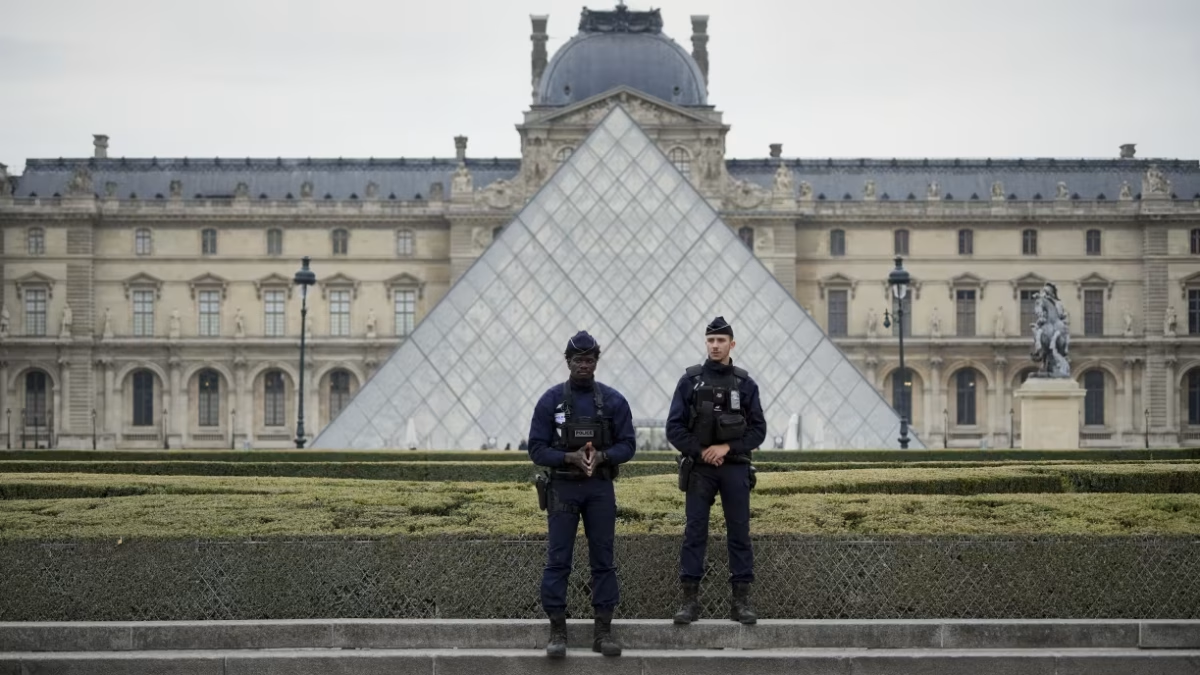
On 19 October 2025, thieves dressed like construction workers pulled off a heist at the Louvre, stealing crown jewels worth about €88 -€102 million in just a few minutes. My initial reaction was pure shock. How could this have happened? Not just any museum, but at the Louvre, the largest and most visited museum in the world.
It reminded me of the same disbelief I felt upon hearing the news of the Notre Dame fire on April 15, 2019, a moment I can still recall as if it happened yesterday. France can’t seem to catch a break. But once the shock settled and I accepted that the Louvre had become the target of a successful heist, I couldn’t help but feel that the museum’s own vulnerabilities and institutional failings made this possible and deserved.
For years, French officials quietly admitted the Louvre’s security was broken. A recent audit found that only about 39% of its rooms had CCTV cameras as of 2024. (The Guardian) Senators called the setup “not in line with modern standards.” (euronews) On top of that, the outside cameras didn’t even cover the balcony the robbers used to break in. (ndtv)
The Culture Minister, Rachida Dati, said there was a “chronic, structural underestimation” of theft risk. (Reuters) The alarms worked, but the protocols didn’t; the robbers got in by cutting a window and leaving with power tools. (WSLS) Some senators point to “weakness” in outdoor camera coverage that helped the thieves. (The Washington Post)
Though, it’s not just about security. There’s a bigger moral layer. Critics say the jewels themselves represent France’s colonial past. Many of the gems were mined in former colonies, and some pieces are tied to imperial eras built on exploitation. (The Washington Post)
For some, the outrage over losing the jewels isn’t just about theft, it’s about failing to face how they were once taken in the first place.
Thus, the Louvre was highly exposed: physical security was weak, priorities imbalanced. The robbers exploited a system that ignored serious warnings. As I would argue, the museum deserved this moment as a brutal reminder, not in a way of defending the crimes that were committed, but because history and neglect caught up to it.
It’s disappointing to have heard such an event taking place at one of the world’s most notable museums. You’d assume that even with these factors in play, the Louvre would be safe from instances of these kinds of situations, but you’d be wrong. It goes on to set the reminder of how even with high status, it does not exempt it from unfortunate cases.